
TWO:The General Congress met at Philadelphia on the 4th of September, when all the delegates, except those of North Carolina, who did not arrive till the 14th, were found to represent twelve States, namely, the four New England States, Virginia, Pennsylvania, Maryland, New York, New Jersey, Delaware, and the two Carolinas. It was settled, however, that, whatever the number of delegates, each colony should have one vote. The next day they assembled in Carpenters' Hall for business, and elected Peyton Randolph, late Speaker of the Virginian House of Burgesses, president. It was soon found that so much diversity of opinion prevailed, it was deemed prudent, in order to preserve the air of unanimity, to deliberate with closed doors. It was clear that Massachusetts and Virginia were ready for war; but it became equally clear that other States yet[213] clung with all the attachment of blood and old connection to the fatherland. Strong and long-continued, according to Mr. Joseph Galloway, one of their own members, were the debates; and though they finally, and, from their system of secrecy, with an air of unanimity, drew up strong resolutions, they were more moderately expressed than the instructions of many of the delegates. They agreed to a Declaration of Rights, in which they asserted that they had neither lost the rights of nature, nor the privileges of Englishmen, by emigration; consequently, that the late Acts of Parliament had been gross violations of those rights, especially as affecting Massachusetts. They therefore passed resolutions to suspend all imports, or use of imported goods, until harmony was restored between Great Britain and her colonies. An association was formed to carry these resolutions out, to which every member subscribed. Having adjourned till the 10th of May of the next year, the Congress dissolved itself on the 26th of October, and the delegates then hastened home to keep alive the flame of their revived zeal in every quarter of the continent.
THREE:An effort was made to decide the long-agitated question of the emancipation of the Jews in the Session of 1849. On the 19th of February Lord John Russell moved that the House of Commons should go into committee for the purpose of considering the oaths taken by members of Parliament, excepting the Roman Catholic oath, settled in 1829. The oath of allegiance, he said, became a mockery when Cardinal York died, there being no descendants of James II. in existence; he therefore proposed to abolish it. The oath of abjuration, which was aimed against Papal aggression, had now no practical effect but to exclude the Jews from Parliament, which it did by the words "on the true faith of a Christian," which were never meant to exclude Jews, but only to give greater solemnity to the oath. He proposed, therefore, to omit these words when the oath was tendered to a Jew, and this he thought would complete the measure of religious liberty. The House resolved by a large majority¡ª214 to 111¡ªto go into committee on the subject. He then moved a resolution that it was expedient to alter the Parliamentary oaths so as "to make provision in respect of the said oaths for the relief of her Majesty's subjects professing the Jewish religion." A Bill founded on this resolution was brought in by Lord John Russell. The second reading was carried by a majority of 278 to 185. The third reading, after an important debate, was carried by a majority of 66. In the House of Lords the second reading was moved on the 26th of July, by the Earl of Carlisle, in an able speech, in which he observed that the Jews, though admitted to municipal privileges, were the only religious community debarred from political rights; but there was not, as far as he could see, a single valid objection upon which they could be refused. The Earl of Eglinton objected to their admission on religious grounds; so also did the Archbishop of Canterbury and the Bishop of Exeter. The former argued that our national Christianity, to which we owed our greatness, would be grievously disparaged by the measure. The latter condemned it as a violation of the distinct contract between the Sovereign and the nation¡ªthat the Crown should maintain "to the utmost the laws of God and the true profession of the Gospel." The Archbishop of Dublin (Whately), always the powerful champion of religious freedom,[603] contended on the other hand that it was inconsistent with the principles and repugnant to the genius of Christianity that civil disqualifications and penalties should be imposed on those who did not conform to it. Their lordships must either retrace their steps, and exclude from office all who did not belong to the Established Church, or they must, in consistency, consent to the abrogation of this last restriction. The Bill was rejected by a majority of 25¡ªthe numbers being, for the second reading, 70; against it, 95.
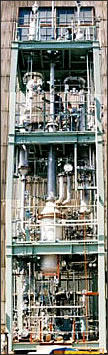
High quality is being demanded in many fields nowadays and so in order to satisfy that we developed a high-purity distillation system in collaboration with Ube industries, Ltd. and Kanto Chemical Co., Inc. The system is used to refine cleaning solutions for the semiconductor industry, medical materials, etc. of high purity (residual ion concentration: 0.01 to 1.0 ppb).
- Our High-purity distillation system provide our clients with high solvent recovery rate, almost 100%.
- The quality of the products/output from our system is very stable, which makes production management very easy, and easier than the conventional ion exchange resin method.
- No emission of waste brings our clients reduction of running cost for environmental measures.
- Our various devices minimize entrainment.
- To prevent the elution of metal, you could ask us the system made of Teflon.
- Our High-purity distillation system has been already proved for solvents that trigger very rapid decomposition reactions, such as hydrogen peroxide.
- Product guide
- Alcohol distillation
- Distillation equipment
- High-purity distillation system
- Membrane separation type solvent dehydration system
- Reactor
- Evaporative concentration equipment
- Coulter spray dryer
- Microwave treatment system
- Filter dryer
- OS filter (continuous vacuum rotating filter)
- Hydrocyclone (liquid cyclone)
- Thermal oil heater (heat medium boiler)
- Process air heater (air heater)
- Ammonia treatment system
- Catalytic deodorizing equipment for ammonia and VOC gas
- Stationary cryogenic storage tank
- Portable cryogenic container
- Cryogenic liquefied gas evaporator